
I have been in correspondence with Dynamax, AgriSupport and Fruition Sciences, hoping to get hold of a set of phytomonitoring sensors for my tree. Thank you to both Thibaut and Mike McClung for their extremely helpful emails.
The question the experts keep throwing back at me is ‘What is it exactly are you trying to measure?’. This is a good question.
It seems that are so many things to look out for. The most obvious are:
- Air temperature, humidity, rainfall, windspeed and direction. Handily there’s a weather station just at the top of my road (it’s the Streatham, London, UK one). It tells me we’ve had 15 days without any rain, that there’s an easterly wind speed of 0.9m/s and humidity is at 57%.
- Soil Moisture and Temperature. At several different depths of course!!
- Soil conductivity. Some soils will obviously conduct electricity better than others due to the different types of salts that may abound. It might be interesting to know whether my tree is ‘plugged in’ in some way.
- Air vapour pressure deficit. This is not something I’ve thought about very much but seems to be critical – “As a general rule, most plants grow well at VPDs of between 0.8 to 0.95 kPa.”
Sometimes I think the tree is trying to graph itself, plotting its own curves, its own rise and fall over time. I see how the branches bend and stretch as the tree blooms, and I like to imagine that maybe I won’t need sensors at all. I shall simply ‘read’ the tree.
On the other hand, there is a fantastic array of kit it would be interesting to install. There are so many things I could be measuring:
- Trunk and stem diameter. It’s kind of obvious now that I think about it that the trunk of the tree and the stems of the main branches can contract and expand on a regular basis. It’s probably the most obvious way of tracking the basic rhythm and status of the tree.
- Leaf temperature. It turns out you can track not just leaf temperature, but check it against the temperature of the soil, the air, and even the blossom!
- Sap flow rate in plant stems and trunks. This is basically a way of tracking ‘transpiration’; i.e I can keep an eye out for when my tree is sweating…
- Blossom colour. I’ve already purchased the Royal Horticultural Society Colour Charts, since I’m assuming that each year there are going to be differences in blossom colour. I’m wondering, in fact, if a laminated Pantone swatch might not come in handy also.
- Canopy analysis. As the seasons progress, I’ll be able to track how the density of the leaves on the trees might be affecting fruit growth.
- Photosynthesis. Apparently I can use a ‘quantum sensor’ to measure accurately “Photosynthetic Photon Flux Density” (PPFD). PPFD is the number of photons in the 400 to 700 nm waveband incident per unit time on a unit surface. I’m not sure what this means.
- Porometry. “Stomatal aperture is the dominant factor in the diffusion conductance of leaf surfaces, which controls both the water loss from plant leaves and the uptake of CO2 for photosynthesis. Measurements of diffusion conductance are therefore important indicators of plant water status and provide a valuable insight into plant growth and plant adaptation to environmental variables.”
- Optical Absorbance Meters for Epidermal Polyphenolics. With these babies I’ll be able to “quickly and quantitatively estimate the concentration of Flavonols and Anthocyans in fruit and vegetables (leaves and skin)”
Obviously this last one is just one of a whole new set of sensors I’m going to need when the tree starts to fruit, but for now the current list of kit will have to suffice. (And anyway I’m getting to the edge of my scientific knowledge – can’t you tell?)
To help me with the money side of things I’m thinking of starting a Kickstarter so that anyone reading this can help me fund this research and share with me the tree’s secrets…
Talking of which, I am already noticing that as the tree blooms it is creating a number of patterns and shapes with its twigs and branches.
Yes, the shapes have been there for a while, I grant you, but somehow the blossom has accentuated things, thrown everything into relief. Just for fun, I traced a few lines onto a couple of photos of the tree. I didn’t stop to think too much; indeed, I tried to make this feel as much like some kind of automatic writing as possible.

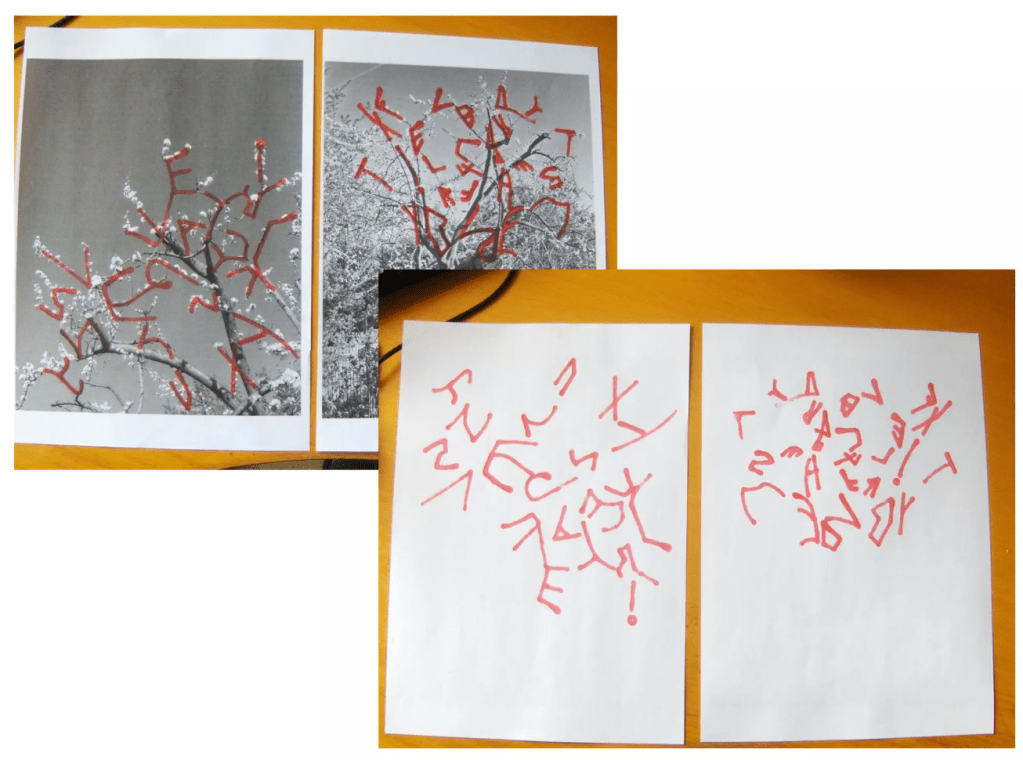
You can see that it came out as a rather compelling collection of letters and ‘runes’. The major surprise, though, was how the felt tip I’d used had come through on the other side of the paper. With the image of the tree taken away I really did have some kind of message.
Obviously I’d like to dismiss it as a freak accident, a quirk of the pen. But I can’t help thinking there’s something here, something to decode. Something that I can work on before the sensors arrive. Can you see it?

 Tim Wright Digital Writer & Producer
Leave a comment