
25 years ago today ‘Online Caroline’ was launched. We claimed it was the world’s first WebCam and email drama. Perhaps it was. Certainly we didn’t know of any other project like it at the time.
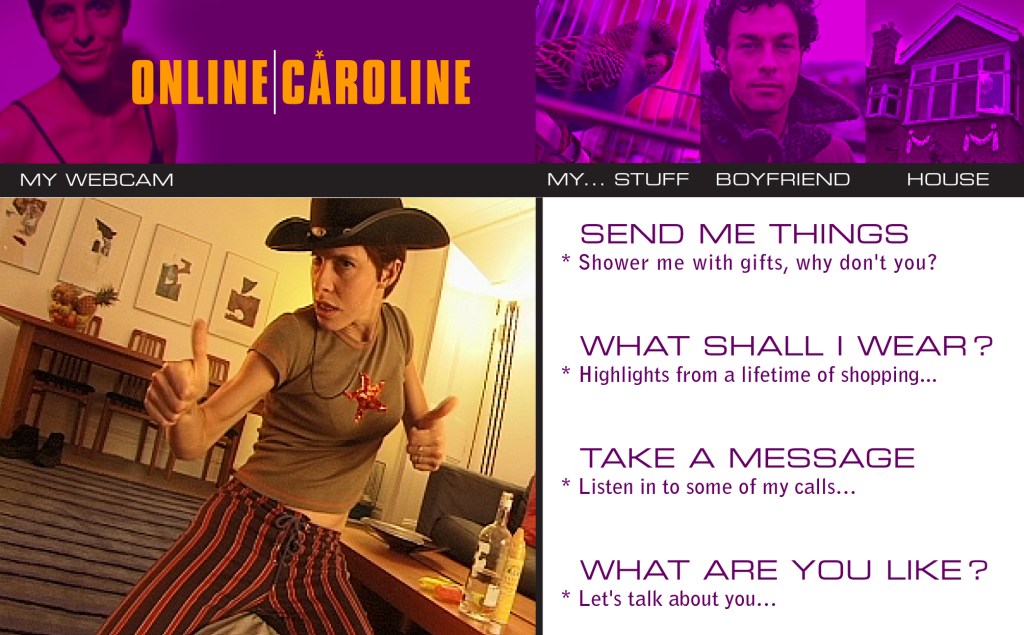
Within weeks of launch we had thousands of new users logging on to watch struggling travel writer Caroline Close live out her life in a London flat and receive emails from her every day explaining what might or might not be going on. The 24 episode Web drama included the witnessing of a burglary, the monitoring of a budgerigar, the sending of odd online gifts (via it3c.co.uk), and participation in the mad food related experiments of Caroline’s menacing boyfriend David.
The combination of seemingly live WebCam footage and highly personalised daily emails created the illusion that Caroline Close was a real person communicating directly with you and only with you.
Hundreds of people took the relationship so seriously that they wrote long emails back to Caroline. (I still have them all stored on an ancient iMac). People would leave voice messages on her ansaphone. A few concerned audience members called the police about what they thought was happening to Caroline. One person came round to my house thinking it might be where Caroline lived.

The project ended up winning an Interactive BAFTA (plus a nomination in second category) and garnered a large amount of press coverage. It also made money! The pounds added up from dialup revenues, banner ads and licensed versions in Germany, Spain and South America. We also added a fair chunk to the valuation of our sugar-daddy investor Freeserve when it was sold to Wanadoo.
If you bother to take a look at the ancient and shonky demo that’s still online, you’d do well to remember that Caroline appeared several years before Facebook, YouTube and Twitter. People were connecting to the Web mainly through low speed modems and the idea of connecting with a friend (or a group of friends) in this intimate multimedia way was a very new concept.
But it does represent a moment in the UK when independent innovation at scale was still possible on the web. A time when small creative start-ups could hope to make a living telling online stories and creating new forms of digital entertainment without relying on giant US platforms for access to audiences.
The dreams we had then for our company XPT and for ourselves in terms of reaching new audiences with exciting new formats now seem endearingly naive.
The web certainly did not develop the way we would have liked.
One of the many reasons you couldn’t (and wouldn’t want to) relaunch a project like this is that so much trust has been lost – not only about what is true and real in an online space, but also about what is responsible and acceptable in terms of behaviour both from the writer/producers and from the audience.
So while I’m still proud of what we achieved with OLC using very limited resources and a small but brilliant team, in terms of creating any kind of model for the type of interactive entertainment that could have thrived in the UK, I can’t help feeling we walked up something of a dead end. Or was it simply the wrong path?
Somewhere along the line (somewhere around 2005-6?) US tech investors, media conglomerates, regulators and broadband audiences chose to take another road that led to where we are now.
Online Caroline is then something of a museum curio; a relic from another time, when we were in the very early days of working out what was real and what was not in the online world.
 Tim Wright Digital Writer & Producer
Leave a comment