
This year is the first time I’ve missed The Story conference since it began. It sounds like a missed a good’un. Instead I was lucky enough to take part in another get-together of smart, funny eclectics at an event called Bees In A Tin, organised by the talented collective called Many & Varied.
The overarching theme of the event was ‘interfaces’, but not your usual interfaces – we had discussions about stonemaking, thronemaking, deejaying, playing, remote-control typewriting, automated bell-ringing, pendulums, programming, dance and movement, walking, foolmaking and more and more and more… It was great. I think I enjoyed the talk about stones the most.

For a full round up of the day and audio recordings of all the main talks I urge you to go here: http://manyandvaried.org.uk/tag/bees_in_a_tin_2014/
My contribution was to manage a workshop about my Compote Tree (see previous blog posts) or rather about the #transmediacompote (or ‘jam’) that comes from my tree.
For the last couple of years I have noodled away at this subject in a series of blog posts and fatuous tweets. This was a chance to step up a bit, and try to make sense of my noodlings in front of – and in collaboration with – a sympathetic smart audience.
I started off thinking about the different ways my tree might communicate via old-fashioned ideas of decoding shapes/symbols or automatic writing – in much the way as Victorians might try to make contact with the dead.
I also wanted to consider how environmmental and physical data gathered about and around the tree might be a form of communication. Could changes in light, heat, humidity etc change the way a tree might talk about itself?
I came across some intriguing articles on the web that suggest the trees are certainly much smarter than we might think about how they communicate not just with animals (including us) but how they communicate with each other and self-organise. Get this from a *very* interesting New Yorker article:
” No-one I spoke to in the loose, interdisciplinary group of scientists working on plant intelligence claims that plants have telekinetic powers or feel emotions. Nor does anyone believe that we will locate a walnut-shaped organ somewhere in plants which processes sensory data and directs plant behavior. More likely, in the scientists’ view, intelligence in plants resembles that exhibited in insect colonies, where it is thought to be an emergent property of a great many mindless individuals organized in a network. Much of the research on plant intelligence has been inspired by the new science of networks, distributed computing, and swarm behavior, which has demonstrated some of the ways in which remarkably brainy behavior can emerge in the absence of actual brains.”
Ultimately, though, I wanted to see how the jam I made from the tree could also be seen as a means of communication. By making ink out of the jam, would we be inspired or even ‘directed’ to draw or write certain messages?
By making fool out of the jam and eating it, might we be ingesting a chemical code that makes us feel different, think differently, behave differently? We already know a little about the effects of dopamine ands seratonin on human emotions and behaviour, so why not consider deeper, more complex interactions between the nervous system, hormonal pathways, the immune system – and jam…?
Could it be that there’s a combination of forces here – a combination of data, writing and jam that might induce active communication between the tree and the human (me) – something perhaps akin to a host being manipulated by a parasite…?
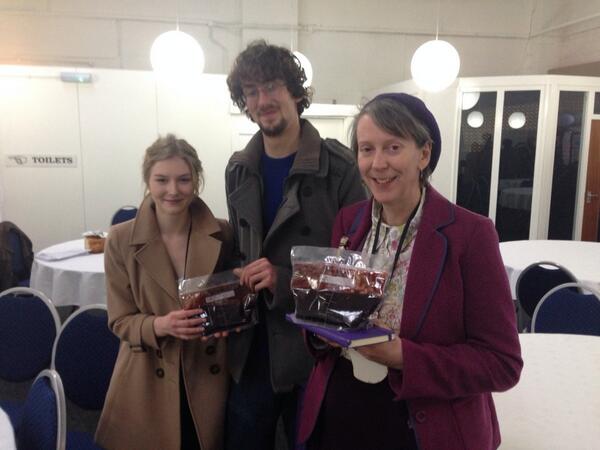
I’m pretty sure we came to no firm conclusuion about any of this at the workshop. The good news, though, was that people quite liked the jam (and the fool), and a lot of discussion was had about the future of talking plants and bringing the vegetable world onto the web. I also recruited a few more compotenauts!
All in all – a fantastic day out.
 Tim Wright Digital Writer & Producer
Leave a comment