
It’s been more than two weeks now since #Dream40 played out both as a live performance in Stratford and a veritable barrage of online activity.
If you want a good description of the project’s ambitions I can do no better than point you at at Tom Uglow’s blog post here. If you want to get a sense of how the project stood up in reality both John Wyver and Peter Kirwan have written interesting posts.
My job on this project was initially to work with the RSC to flesh out a realistic and fairly specific online plan that would make good on the theory so entertainingly sketched out by Google’s Tom Uglow.
This involved creating an initial set of ‘2nd level’ characters who could act both as witnesses of the play’s events and as reporters of the play’s magical and entrancing language, so we didn’t drift too far away from Shakespeare’s original work and might entice audiences back down to the ‘1st level’ live performance of the play.
(It was one of the major criticisms of another online project I worked on with the RSC – Such Tweet Sorrow – that it ended up having very little connection with Shakespeare in terms of language and performance.)
The ‘2nd level’ characters also gave us an opportunity to present a series of related stories that could reinforce and elaborate on the central themes of the play – love and marriage, love at first sight, the battle of the sexes, illicit sex, belief in faeries and the pagan world, the lure of the forest, English folklore, flora and fauna, amateur dramatics, moonlight and music…
Having mapped out a rough world of courtiers, mechanicals, fairies and lovers, we then enjoyed some terrific brainstorming sessions with a group of very talented writers, working at breakneck speed to map out 50 characters and fictionalised media outlets all accessible on Google+, all posting regularly over a period of several days, and all staying always in synch with the live performance and with each other.
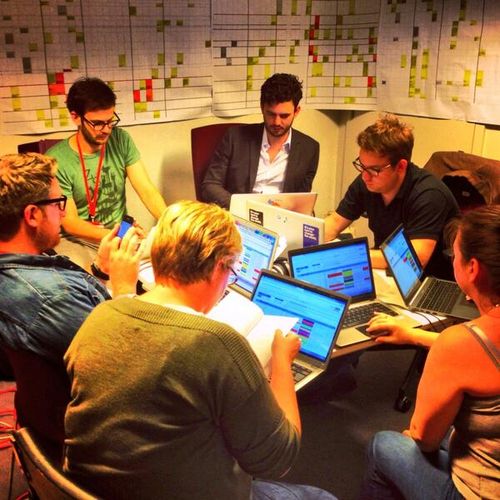
The task for me at this point was to ‘grid out’ all the different updates across all the accounts so that they made sense both as a collection of individual Google+ user accounts with their own stories to tell, and as a way for an online audience to interact with characters and contribute ideas and content to the production —*and* it had to work as the online lens through which the live event could continue to enjoyed, celebrated and ‘glimpsed’ from afar.
This idea of ‘glimpsing’ btw as opposed to seeing or experiencing an artistic or cultural event is becoming rather topical at the moment. Consider, for example, how we tend to keep track of rolling news stories through ‘glimpses’ provided by Youtube updates, tweets, blog posts, user comments, mobile phone pics etc. Or indeed how Tom Uglow offered ‘glimpses’ of the behind-the-scenes work on the production using Storify. For another interesting use of the ‘G-word’ (‘Glimpse’ not ‘Google’) see this James Bridle interview (he uses it at 2’38”).
Back to #dream40 – the grid proved to be a MONSTER and left the writers with the truly mammoth task of populating the timeline with ever increasingly wacky and strange content, characters and story ideas.
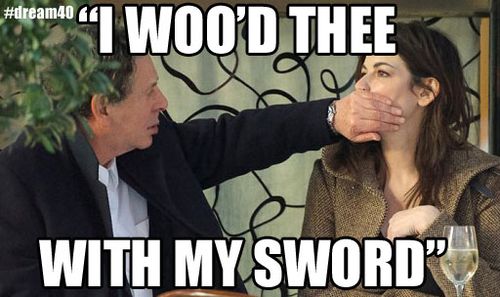
We all mucked in with the generation of memes, photos, films, as did a hard core of highly active audience members working with the encouragement of both Puck and Billy Shakespeare.
The result was an absolute flood of content all marked with the #dream40 hashtag, and when we first launched on the Friday, even with the help Google’s dashboard concept, even I found it hard to to follow what was going on.
And yet this did seem to mimic the frenzy that often happens when a live event kicks off. It starts with a single Tweet or G+ post, you follow a hashtag, you’re still not sure about exactly what’s kicking off, you are drawn into one or two particular user feeds, you find some photos or a video, you start to work out the ‘story’, you chart the timeline of what’s been happening and from an immense gallery of ‘glimpses’, you start to create a picture for yourself of what’s happening, you can start to feel like you’re part of the event as you feed off the energy and wit of particular witnesses or commentators or friends.
Whether the one-off performance of a Shakespeare play can create the kind of online ‘buzz’ that goes on when a Test match is on (like today) or a massive protest is taking place is questionable. It’s pretty clear that #dream40 didn’t go gangbusters in terms of online audience numbers. Nevertheless, following all the individual character updates was a real pleasure with the broad range of media and formats being used to tell stories online, employing Youtube videos, Pinterest boards, WordPress articles, Soundcloud accounts and on and on. And it was a great platform for showcasing the wit and talent of our dream team of writers.
Personal favourites were the poems of Justin Snout and the infographics and instructional videos of Dr Bernard Hermes.
Opportunities to work on a complex and rich interactive stoytelling project such as this, supported by organisations like Google and the RSC with serious resources and reach, don’t come along too often these days (trust me, I’ve been doing this kind of thing since 1995). The RSC in particular deserves enormous credit for pursuing a line of online experimentation over several years that has included Such Tweet Sorrow, Adelaide Road and is currently continuing with @TweetCandide.
I’d mark down #dream40 as an interesting experiment rather than a roaring success. But I do think it provides a ‘glimpse’ of how audiences on the web are going to get involved in new forms of live performance and participation in the near future.
 Tim Wright Digital Writer & Producer
Leave a comment