
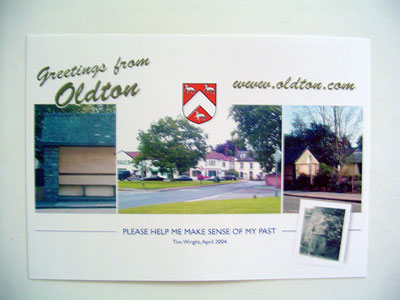
How luxk I am to have the support of TrACe. With its help (and prompting of the idea), there are now Oldton postcards that can be sent out or left about the place so that people who want to contribute to the project without going online can do so.
The other good news is that I seem to have at last come up with a half-decent definition of what Oldton is all about:
With ‘In Search of Oldton’, I plan to work together with people – online and offline – to build up digital evidence of a town that never really existed.
I am very keen for the project to encourage as many people as possible to try their hand at writing in a digital environment and to explore what it might mean to have a literary experience online.
I want my audience to send me any number of texts, pictures, illustrations, sounds, videos and memorabilia that I can use to build up a detailed portait of my old home town. The only rule about submissions is that they must be about a place or a person that has been lost or left behind.
It will then be up to me to fit these personal fragments of memory and farewell into a coherent digital story.
I claim Oldton as my old home town, because it represents for me two important things that I lost in my own life, things that somehow still manage to be a significant part of who I am: one is my father, who committed suicide several years ago, and the other is the innocent and happy childhood I enjoyed in a secure and peaceful rural environment in the ‘pre-digital’ 1960s and early 1970s.
I can never get these things back in real life. But perhaps through an imaginative act of digital reincarnation, I can come to terms with my loss. Perhaps a *virtual* return to Eden is possible…
A 90% true story
The project is a deliberate confusion of fictional storytelling and an exploration of my personal life, with the aim of discovering and defining some kind of emotional truth about my past.
This, to me, seems like a natural way for a digital writer to use the online environment – to create something of emotional significance out of the multiplicity of impersonal interactions and chaotic, shared media that the Web offers.
It is true that when I was six, we left a small village in the country where I was very happy. It is also true that much later my father killed himself. In my digital story, however, I have changed the sequence of events and compressed the period of time in which these events happened – much as anyone does when engaging with an interactive environment, whether it be a Web site or a CD ROM or a game.
We chop and change the order in which we look at things. We dwell in some areas of the virtual environment for longer than in others. Some areas we never visit at all.
I wanted to create a digital story in which I could do the same kind of thing with my own past. And by doing so, I’m hoping to reveal something about how digital narratives can unlock a different kind of ‘truth’ about common human experiences.
I have deliberately divided the work into a series of illustrated ‘left hand’ pages and a collection of ‘right handed’ textual notes. (I am left-handed, my father was right-handed.)
I want the online reader to be able to click through the left hand pages, or follow the right hand textual notes in sequence, *OR* click links embedded into both areas to create a hypertextual path through the work.
In this way, the work itself can be emerge as a conventional illustrated book or journal, as a structured (and credited) collection of the audience’s contribution, as well as existing as a piece of hypertext fiction.
‘In Search of Oldton’ is also, for me, a modest attempt to retell the Eden myth at a time of great technological revolution, when human beings are beginning to wonder what kind of animals we might become in a 24×7 virtual world, and what we all might lose by evolving in this way.
 Tim Wright Digital Writer & Producer
Leave a comment